The dirty secret of the online learning boom is that consuming content and actually acquiring a skill are two profoundly different things. Watching someone else code, cook, or play guitar is, neurologically speaking, a lot closer to watching TV than it is to learning.
The platforms that actually work aren’t necessarily the most popular ones. They’re built around what cognitive scientists call the learning trifecta: spaced repetition (revisiting material at increasing intervals), active recall (forcing yourself to retrieve information rather than passively re-read it), and desirable difficulty (making practice just hard enough that your brain has to work). Most mainstream platforms ignore all three in favor of something more commercially appealing: the feeling of progress.
The following seven websites are different. They’re built around how memory and skill formation actually work.
1. Anki
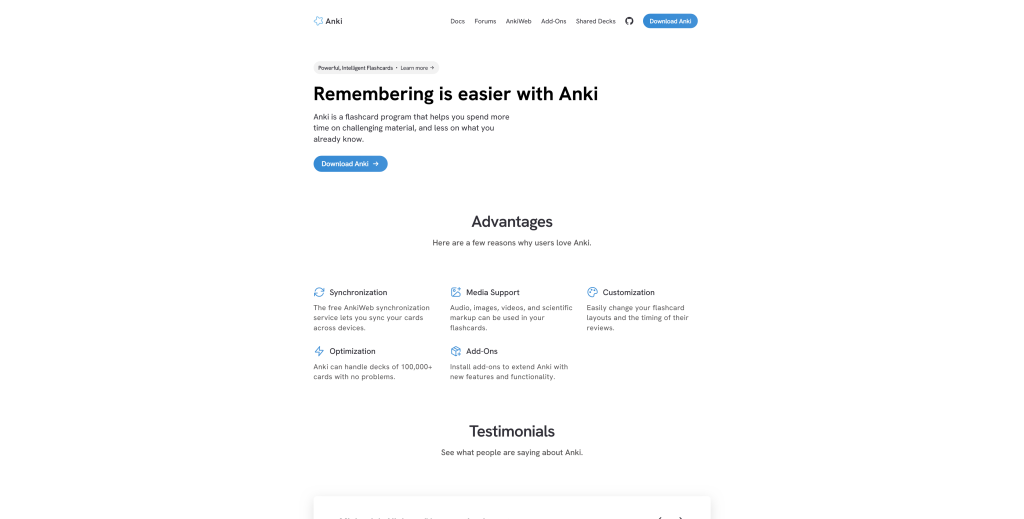
Anki remains stubbornly under-used outside of medical school circles. Anki is a flashcard application powered by the SM-2 spaced repetition algorithm, a system that schedules each card for review at precisely the moment you’re about to forget it. The result is a learning loop that feels almost eerily efficient.
What makes Anki exceptional isn’t the interface (which is famously ugly) or the learning curve (which is genuinely steep). It’s the underlying philosophy: every review session is an act of active recall, not passive recognition. You don’t read the answer: you try to produce it. That distinction sounds small. Decades of cognitive psychology research say it’s enormous.
Medical students have used Anki to memorize thousands of pharmacological interactions. Language learners have built vocabularies of 10,000+ words. Musicians use it to internalize chord theory. The software is free and open-source, with a vast library of community-made decks covering everything from AP Chemistry to the works of Dostoevsky. The mobile app costs a one-time fee on iOS but is free on Android. The real investment is the time required to build good cards. However, that process itself, it turns out, is one of the most powerful learning activities you can do.
2. Khan Academy
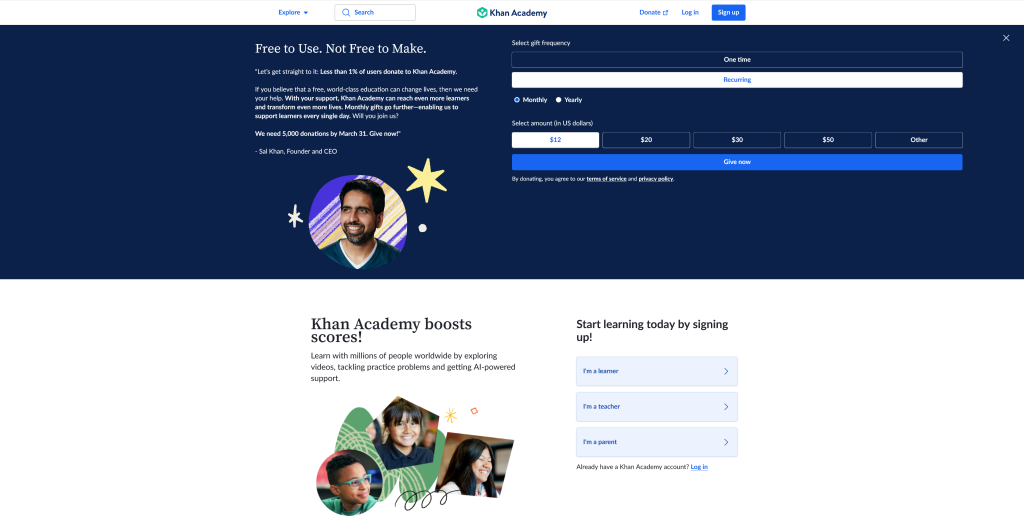
Underneath Khan Academy’s approachable, K-12-friendly exterior is one of the most carefully scaffolded learning systems available online, and it’s entirely free.
What sets Khan Academy apart from other video-based platforms is its mastery learning model. You don’t simply watch a video and move on. Each concept is followed by problem sets, and the platform tracks your performance across multiple attempts over time. If you struggle with a concept, it surfaces prerequisite topics you may have missed. If you demonstrate consistent fluency, it advances you. The system is built around the insight that gaps in foundational knowledge are what cause most people to hit walls in subjects like math or science.
For adult learners returning to academic subjects, Khan Academy’s patience is particularly valuable. It never assumes you’re embarrassed about where you’re starting from, and it never lets you fake understanding and move on. The platform’s MCAT prep and SAT prep sections are especially comprehensive, but its real strength is anyone who needs to rebuild a foundation they thought they’d lost.
3. Brilliant
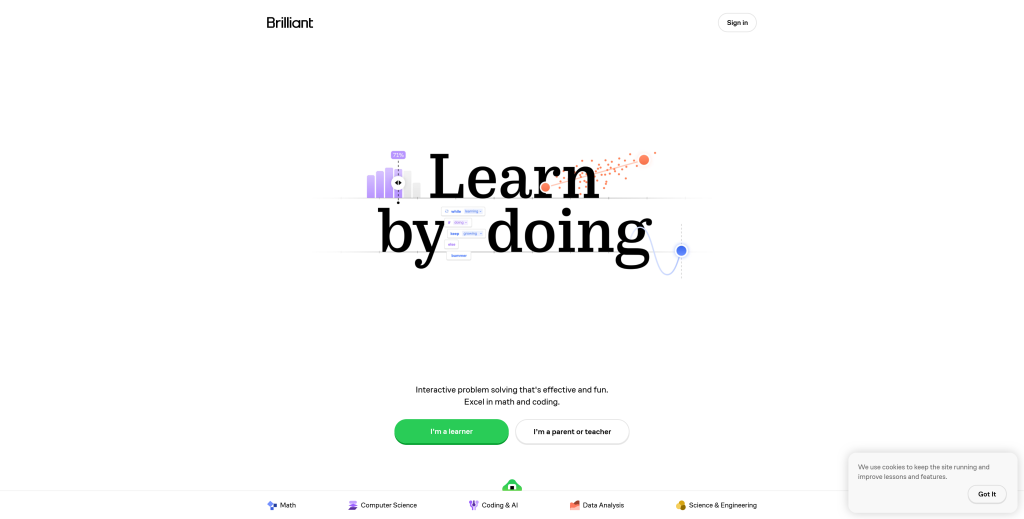
Brilliant teaches mathematics, science, and computer science almost entirely through problem-solving. You are never given a concept and then asked to apply it. You are given a puzzle, asked to reason through it, and the concept emerges from your struggle with the problem.
This approach, called inquiry-based learning, has strong backing in educational research. When you construct an understanding yourself rather than receive it from a lecture, the knowledge integrates more deeply into your existing mental models. Brilliant makes this feel less like suffering and more like play, through elegant UI, bite-sized lessons, and a genuine sense of discovery built into each topic.
Brilliant works best for quantitative and logical thinking skills: probability, number theory, logic puzzles, neural networks, algorithm design. It won’t teach you to write or draw, but for analytical reasoning, it may be the most neurologically honest platform available. The subscription is paid, but the quality of thinking it develops is one of the more transferable skills an adult learner can build.
4. Coursera
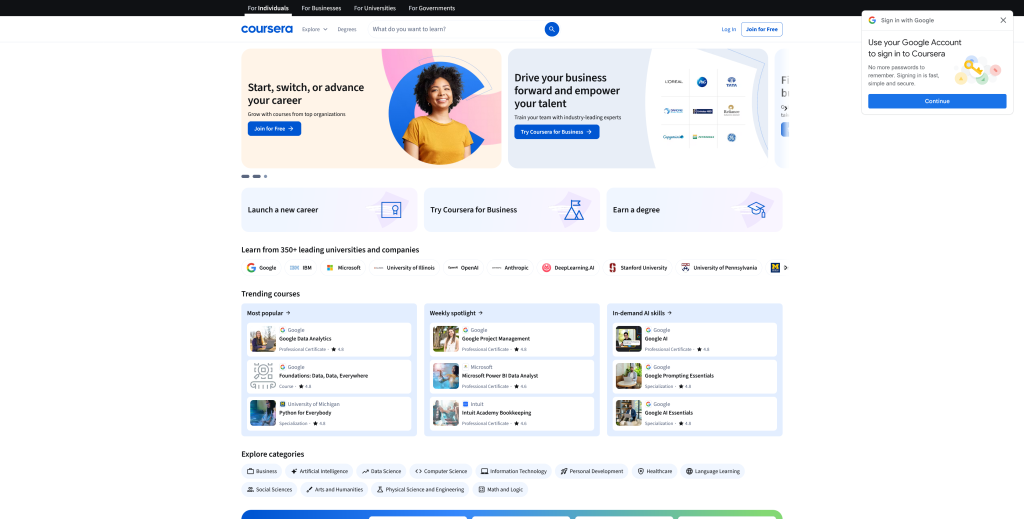
Coursera makes this list for one specific feature: peer-reviewed assignments and hands-on projects. When Coursera courses are structured around doing, the retention outcomes are dramatically better than anything passive.
The caveat is selectivity. Many Coursera courses are little more than video playlists with a quiz at the end. The ones worth your time are the specializations and professional certificates from universities like Johns Hopkins, Stanford, and the University of Michigan, which build assignments that force you to apply concepts rather than recognize them. Google’s data analytics and project management certificates, for example, are structured around simulated workplace tasks that mirror actual job conditions.
Coursera also offers financial aid that genuinely covers the full cost of most certificates for learners who qualify. The platform is worth your attention when you’re choosing courses that have graded projects and peer review built in, and worth skipping when the “course” is essentially a YouTube channel in disguise.
5. CodeAcademy
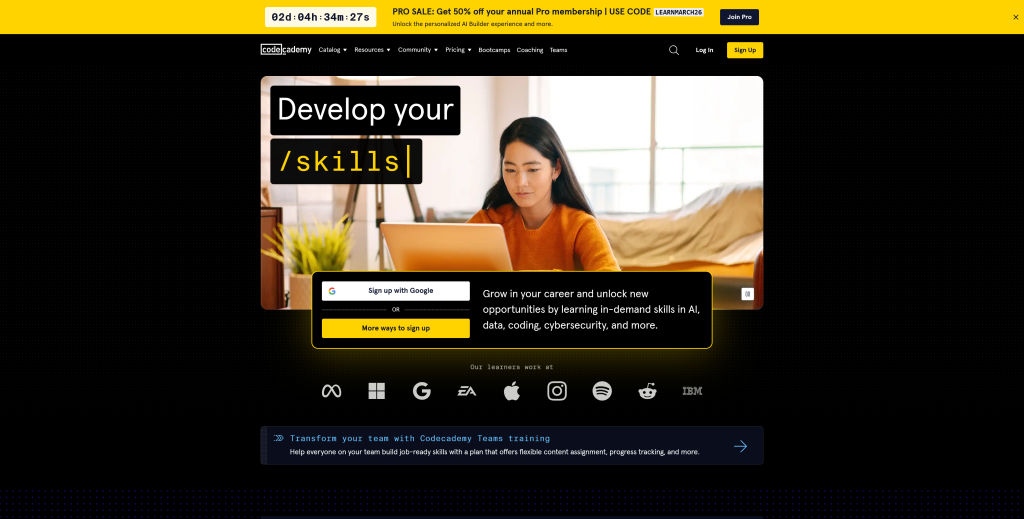
Learning to code presents a specific pedagogical challenge: the gap between understanding a concept and being able to implement it is unusually wide. Most people who learn to code by reading or watching videos can follow along just fine, and then open a blank file and freeze completely. Codecademy was built specifically to close that gap.
Every lesson on Codecademy is interactive. You write code inside the browser. You see the output. You fix the errors. There is no learning without doing. The platform literally won’t let you move forward until you’ve run working code. The result is that even beginners with no programming background develop genuine procedural fluency rather than an illusion of it.
Codecademy’s strongest tracks are in Python, JavaScript, SQL, and web development. Its career paths, which string together multiple courses into a coherent skill sequence with portfolio projects at the end, are particularly well-constructed for learners who want a concrete outcome rather than scattered knowledge. The free tier is genuinely useful; the paid Pro tier adds quizzes, projects, and interview prep that significantly deepen retention. For anyone starting their first programming language, Codecademy provides something most platforms don’t: the experience of things actually working because you made them work.
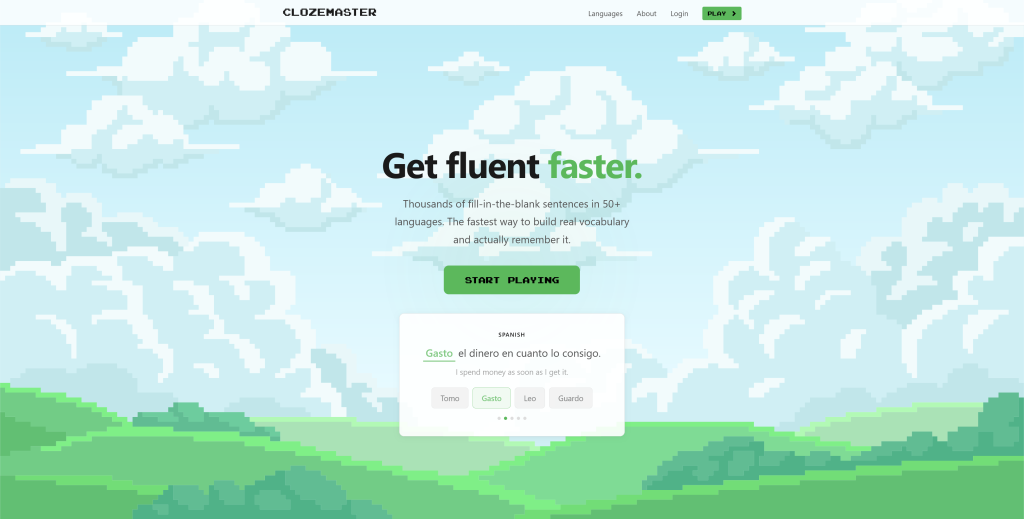
Language learning apps tend to cluster at two extremes: gentle gamification, which is excellent for beginners and loses its usefulness around the intermediate level, and immersive input methods like watching native-language TV, which are frustrating and inefficient for anyone below advanced fluency. Clozemaster fills the middle ground with effectively.
The site presents sentences from real texts with a single word removed. Your job is to supply the missing word from context. This cloze deletion method forces you to engage with vocabulary in authentic usage rather than in sterile word-pair flashcards, and the sentence-level context makes retention dramatically stronger. Over time, you’re not just learning what a word means, you’re internalizing the grammatical structures and collocations that surround it.
Clozemaster supports dozens of language pairs and is built on a spaced repetition backbone, so sentences resurface as you’re about to forget them. The free tier is generous. The platform is best used as a complement to other learning methods — once you’ve got a vocabulary of perhaps 500–1000 words in your target language and want to develop genuine fluency rather than tourist survival phrases. It’s unglamorous and addictive in the best possible way.
7. Scott Young’s Blog & Learning Resources
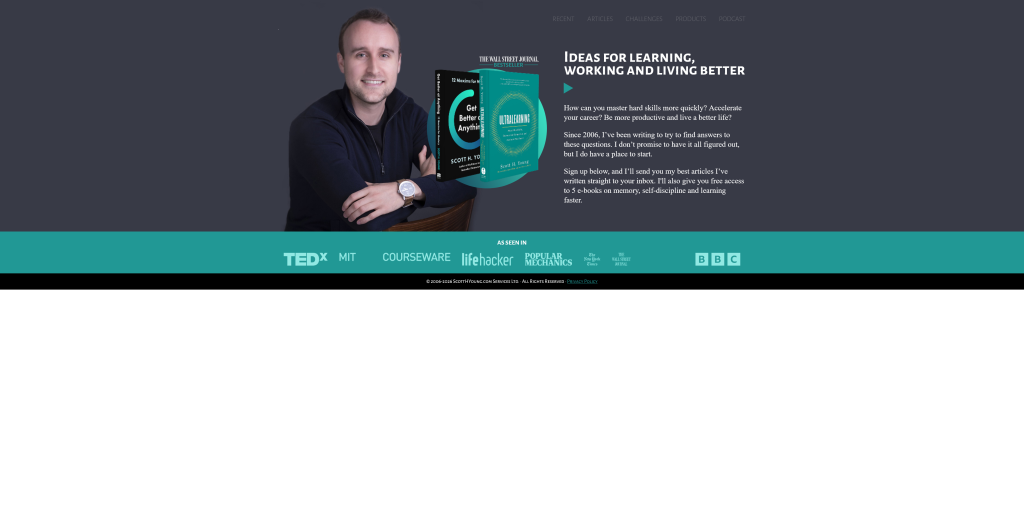
This is a resource that teaches you how to learn. Scott H. Young is the person who completed MIT’s four-year computer science curriculum in twelve months without enrolling, and he has spent the years since researching and writing about the mechanics of accelerated skill acquisition.
His blog and books cover concepts like the Feynman Technique (explaining a concept in plain language to expose gaps in your understanding), ultralearning (intensive, self-directed projects that force rapid skill acquisition), and the specific ways that most self-study fails, usually through passive re-reading rather than active practice, or through drilling isolated skills rather than integrating them into realistic contexts.
What makes Scott’s work practical is its specificity. He doesn’t write motivational content about the importance of learning. He writes about exactly how to structure a practice session for a musical instrument, why interleaved practice beats blocked practice for long-term retention, and how to design a project that gives you feedback loops tight enough to actually improve. For anyone who is serious about learning anything, spending a few hours with his writing will change how you structure every learning session that follows. The content is mostly free, with books and courses available for deeper dives.
Want more? Browse hundreds of curated education and reference websites in the Sevenseek Education Directory.